Once you have established those 4C characteristics that are most important to you, a jeweler can then begin to show you various options with quoted prices.
Cut refers to the angles and proportions created in transforming a rough diamond into a polished diamond.
A well-cut diamond will reflect light internally from one mirror-like facet to another, dispersing it through the table of the stone. The cut of a diamond allows it to make the best use of light. When a diamond is cut correctly, light is reflected from one facet to another, and then dispersed through the top of the stone. If the cut of the diamond is too deep, some light escapes through the opposite side of the pavilion. If the cut is too shallow, light escapes through the pavilion before it can be reflected.
Cuts that are too deep or too shallow lose or leak light through the side or bottom (affecting the diamond's brilliance).
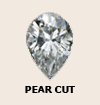
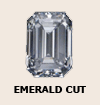
The most popular diamond shapes are round, marquise, pear, emerald, oval and heart.
Whatever the shape, a well-cut diamond is the work of a master diamond cutter. When the cut is right the diamond gives more sparkle.
* Facets:
Diamond cutting requires great skill and training, because the diamond polisher-cutter must polish tiny surfaces known as facets (crown, culet, table, girdle, and pavilion) onto the rough diamond in a very precise manner.
The facets, when arranged in precise proportions, will maximize the fire, life, and brilliance of a diamond.
It should be noted that to cut a diamond perfectly, a diamond polisher will often need to cut away more than 50% of the rough diamond thereby seriously affecting the yield of the rough (the consideration being for beauty not for carat weight).
Ideal cuts and hearts and arrows diamonds are examples of diamonds that have been cut for maximum brilliance and light performance and not for weight retention.
Depending on the facet design, cutting styles are categorized into 3 basic types:
Step-cut, brilliant-cut, and mixed-cut.
Until some of the new patented branded cuts, brilliant cuts were thought to reflect the most light.
Step-cuts have rows of facets. (The emerald is an example of this cutting style.)
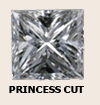
Mixed-cuts have both step and brilliant-cut facets. (One of the most popular is the princess.)
* Shape:
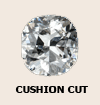
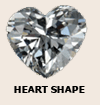
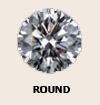
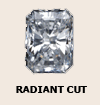
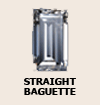
Cut may also refer to the shape of a diamond: round, emerald, heart, marquise, princess, lily cut, caressa, crisscut, etc.
* Accuracy + Symmetry + Facet Design = Light Performance
Perhaps, the most exciting new feature (as seen in a number of grading reports or with separate certification) is the evaluation of the performance of light of a diamond's cut. Light performance is a function of facet design, accuracy, and symmetry.
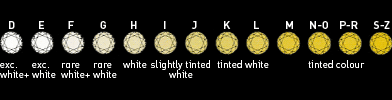
Diamonds range in color from faint yellow or brown to very rare pinks, blues, greens, and other colors known as "fancies." Natural fancy colors that are found in nature include: pink, blue, green, yellow, brown and orange very rarely, red.
These are incredibly rare and valuable.
The best color for a diamond is no color at all. A totally colorless diamond allows light to pass through it easily, resulting in the light being dispersed as the color of the rainbow.
Colors are graded from totally colorless to light yellow. The differences from one grade to the other are very subtle and it takes a trained eye and years of experience to color grade a diamond.
In the past, colors were classified with more interesting names including commercial, wesselton, top light brown, silver cape, cape, off-white, river, and many more.
Today some diamonds are classified with more descriptive names such as vivid yellow, fancy yellow, vivid pink, champagne, coffee, smokey, amber, and cognac.
|
 |
 |
 |
 |
|
Internally Flawless |
Very Very Slightly
Included |
Very Slightly Included |
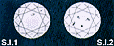
Slightly Included |
|
Free from internal blemishes
visible under 10x magnification (small
external details tolerated). |
Inclusions and/or external
blemishes very difficult to locate under 10x
magnification. |
Inclusions and external
blemishes difficult to locate under 10x
magnification. |
Inclusions and external
blemishes easy to locate under 10x
magnification. |
Rough diamonds have natural blemishes (inclusions) in their internal structure which are formed by minerals or fractures while the diamond is forming in the earth.
When a diamond is polished, light enters it and is subsequently reflected and refracted out.
If there is anything disrupting the flow of light in the diamond, such as an inclusion, a proportion of the light reflected will be lost.
Because most inclusions are not visible to the naked eye unless magnified, to view inclusions, trained gemologists use a magnifying loupe (to see a diamond at 10x its actual size).
A grading method that rates diamonds on the size, nature, and positioning of the inclusion requires an expert eye to assess.
Clarity descriptions range from IF (Internally Flawless - no visible characteristics under magnification) to I (Included - characteristics visible with the naked eye). VVS is Very, Very Slightly Included and to VS is Very Slightly Included.
Inclusions appear as different shapes, such as crystals, clouds or feathers. (The majority of these natural birthmarks are invisible to the naked eye, yet they affect the way light is reflected and refracted within the stone. Diamonds that have no inclusions under magnification are extremely rare and are rated FL for flawless.)
Diamonds have the capability of producing more brilliance than any other gemstone. A diamond that is free of inclusions and surface blemishes is very rare and therefore very valuable.
 |
 |
 |
 |
 |
 |
|
Carat |
0.25 |
0.50 |
0.70 |
0.90 |
1.00 |
|
Øm/ m |
4.1 |
5.2 |
5.8 |
6.3 |
6.5 |
 |
 |
 |
 |
 |
 |
|
Carat |
1.25 |
1.50 |
2.00 |
2.50 |
3.00 |
|
Øm/ m |
6.9 |
7.4 |
8.2 |
8.8 |
9.4 |
This is the weight of a diamond measured in carats. A carat is a measure of weight. (Carat weight is one of the factors to take into consideration when choosing a diamond.)
A carat is sometimes confused with size (diameter/depth) even though it is actually a measure of weight.
Carat with a C should not be confused with Karat with a K
Carat (with a C) is for diamonds. Its source of reference is the carob seed.
One carat is divided into 100 "points," so that a diamond of 75 points weights .75 ct.
The carat-weight of a diamond is the easiest measurement to determine.
Most importantly, two diamonds can be of equal carat-weight, but their value can differ greatly due to their cut, color, and clarity.
|